Laparoscopic (keyhole) surgery in Goa: what it treats
Laparoscopic (keyhole) surgery in Goa uses two or three small cuts, each under a centimetre, instead of one large incision. A thin camera and fine instruments go in through these cuts, so the surgeon works looking at a screen rather than opening the abdomen. Smaller cuts generally mean less pain afterwards and a shorter hospital stay than open surgery.
Open 24 hours for pregnancy and gynaecology emergencies. Complex gynaecological surgeries are done in our own operation theatre.
What laparoscopic surgery is used for
At Pai Hospital, laparoscopy is the first-choice approach for most gynaecological operations that used to need a large abdominal cut. It is used to remove fibroids (myomectomy), remove the uterus (hysterectomy) when a vaginal approach on its own is not suitable, treat endometriosis, remove ovarian cysts, and free up adhesions (internal scar tissue). It is also used for an ectopic pregnancy in a tube: read about laparoscopic salpingostomy for an ectopic pregnancy. Each is a different operation for a different reason — the sections below explain each one in plain terms.
Conditions treated by laparoscopic surgery at Pai Hospital
Each row is a different operation for a different problem. The page in the last column explains it in full.
| Condition | Operation | Read more |
|---|---|---|
| Fibroids, when the uterus is kept | Laparoscopic myomectomy: the fibroids are removed and the uterus is repaired | Myomectomy in Goa |
| A uterus that needs removing | Laparoscopic hysterectomy, or a vaginal hysterectomy where that suits | Hysterectomy in Goa |
| An ovarian cyst that stays, grows, looks complex or causes pain | Laparoscopic ovarian cystectomy, keeping the healthy ovary tissue | Ovarian cyst surgery in Goa |
| Endometriosis | Laparoscopy to confirm it and to remove or cauterise the deposits | Endometriosis treatment in Goa |
| Adenomyosis | Medicines first for many women; a procedure only when it suits the symptoms and the plans for a family | Adenomyosis treatment in Goa |
| An ectopic pregnancy in the tube | Laparoscopic salpingostomy, which keeps the tube, or removal of the tube | Tube-saving surgery for an ectopic pregnancy |
| Difficulty conceiving, or pelvic pain a scan cannot explain | Diagnostic hysterolaparoscopy: a keyhole look at the tubes and the pelvis, and a camera inside the womb, under one anaesthetic | Diagnostic hysterolaparoscopy |
| A septum dividing the inside of the womb | Hysteroscopic septum resection, with no cut on the tummy; a keyhole camera may check the outside of the womb in the same sitting | Septum resection |
Adhesions (internal scar tissue) are freed by laparoscopy too, as explained below.
Endometriosis
Endometriosis is tissue similar to the lining of the uterus growing where it does not belong — usually on the ovaries, the fallopian tubes, or the lining of the pelvis. Every month this tissue responds to the same hormones as the uterine lining does, which is what causes the pain: period pain that is worse than usual, pain during sex, or pain that does not go away between periods. It can also make conceiving harder, which is why it often comes up during a fertility work-up as much as a surgical one, and why laparoscopy for infertility is sometimes part of that work-up.
Watch on YouTube if the player does not load.
Laparoscopy is used both to diagnose endometriosis — it is often the only way to see the deposits directly — and to treat it in the same operation, by removing or cauterising what is found. Surgery is not always the first step. Many women are managed first with pain relief or hormonal treatment, and laparoscopy is kept for pain that does not settle, or for deposits that may be affecting fertility.
Ovarian cysts: when is keyhole removal needed?
An ovarian cyst is a fluid-filled sac on the ovary. Most are simple, functional cysts that form and disappear on their own within a cycle or two, and need nothing more than a repeat scan to confirm they have gone. Laparoscopic removal (cystectomy) is kept for cysts that persist over several cycles, are large, look complex on scan, or are causing pain — including the sudden severe pain of a cyst twisting on itself, which needs urgent attention. The aim of a laparoscopic cystectomy is to remove the cyst while leaving the healthy ovary tissue in place. Read more about ovarian cyst surgery in Goa, including which cysts need an operation.
Adhesions
Adhesions are bands of scar tissue that form inside the abdomen or pelvis after previous surgery, infection, or endometriosis, sticking organs together that should move freely. They can cause chronic pelvic pain, and if they involve the fallopian tubes, they can affect fertility. Laparoscopy is used to see exactly where the adhesions are and divide them (adhesiolysis), which is usually far less disruptive to the surrounding tissue than reopening the abdomen would be. Pain that starts after one or more caesareans is a common reason to look; our guide to adhesions after a C-section explains when a laparoscopy helps and what it cannot do.
Hysteroscopy is not keyhole surgery
No cut is made anywhere for a hysteroscopy. A hysteroscope — a thin telescope — is passed through the vagina and the cervix, the same natural passage a period comes through, directly into the uterus. There is no abdominal incision at all, which is the key difference from laparoscopy. It is used to look inside the uterine cavity itself: to investigate abnormal bleeding, to check for polyps or fibroids bulging into the cavity, or to look for scar tissue inside the uterus. Many hysteroscopies are diagnostic and operative in the same short visit, and a large number are done as a day procedure with no overnight stay at all.
Confusing the two puts women off a genuinely simple investigation. If a doctor has suggested a hysteroscopy to find out why a period is heavy or irregular, it is worth understanding it separately from an operation that involves cuts — it is a much smaller step. Read more about hysteroscopy in Goa, including what happens on the day.
Tests before keyhole surgery
Before a planned keyhole operation, a few checks confirm that it is the right operation for you and that you are fit for the anaesthetic:
- A recent ultrasound scan, to see the size and position of the fibroid, cyst or other problem. Occasionally a further scan is advised when the ultrasound alone does not answer the question.
- Blood and urine tests, such as a blood count, blood group and blood sugar, and any other tests your doctor or the anaesthesiologist asks for. The hospital's own laboratory, on the ground floor, does routine tests in-house and is open 24 hours.
- A pregnancy test, whenever there is any chance of a pregnancy.
- An ECG, and sometimes a chest X-ray, depending on your age and health.
- A meeting with the anaesthesiologist before the day; read about anaesthesia during gynaecological surgery.
Bring your earlier scan reports and a list of the medicines you take, so the team can tell you which to continue before the operation. Which tests you need depends on the operation and on your health, and is explained at the consultation.
Keyhole surgery and fertility
For a woman who hopes to become pregnant, laparoscopy can do two jobs. It can find a cause: a dye test shows whether the tubes are open, and the camera shows endometriosis or adhesions that a scan often misses. When the inside of the womb is checked in the same sitting, the procedure is a diagnostic hysterolaparoscopy in Vasco. It can also treat what it finds, such as endometriosis, adhesions around the tubes and ovaries, an ovarian cyst or a fibroid, if you agreed to that beforehand.
When a pregnancy is wanted, the surgeon works to protect the ovaries and the tubes. Removing an endometrioma, for example, can lower the ovary's egg reserve, so the need for surgery and its timing are planned together with fertility tests such as AMH. An operation can remove a problem that stands in the way of a pregnancy, but no operation can promise one.
Recovery after laparoscopic surgery
Most laparoscopic gynaecological operations at Pai Hospital are a one- or two-night stay, sometimes day-care depending on the operation. Expect some shoulder-tip discomfort for a day or two — from the gas used to create room to work in, not from the surgery itself — along with mild soreness around the small cuts. Most women are back to light activity within a week or two, and to full activity within four to six weeks, though this varies with the operation and with how physically demanding your normal routine is. After a keyhole hysterectomy, for example, most women go home in one to two days and are back to light work in two to three weeks. Read more about keyhole surgery recovery time.
When surgery is not the answer
Not every fibroid, cyst, or endometriosis diagnosis needs an operation. Small fibroids or cysts with no symptoms are often simply watched with a repeat scan. Endometriosis pain is frequently managed first with medication. Surgery is the right step when symptoms are significant, when a cyst or fibroid is behaving in a way that needs investigation, or when fertility is being affected — and deciding which of those applies to you needs an examination and your own scan, not a general rule.
Laparoscopic surgeon in Goa
Our laparoscopic surgeon has been practising for 15 years and performs these operations himself, in the hospital's own operating theatre. The doctor you consult is the doctor who operates, and you know before you are admitted whose hands you are in. The conditions he most often operates on:
- Fibroids, from watching and waiting to keyhole removal: fibroid treatment in Goa.
- A uterus that needs removing, by keyhole surgery where that suits: laparoscopic hysterectomy.
- A cyst that stays, grows or causes pain, removed while keeping the ovary: ovarian cyst surgery in Goa.
- Painful periods, pelvic pain or difficulty conceiving from endometriosis: endometriosis treatment in Goa.
- Polyps, a septum or scarring inside the womb, treated with a camera and no cut: hysteroscopy in Goa.
Laparoscopic gynaecological surgery team at Pai Hospital
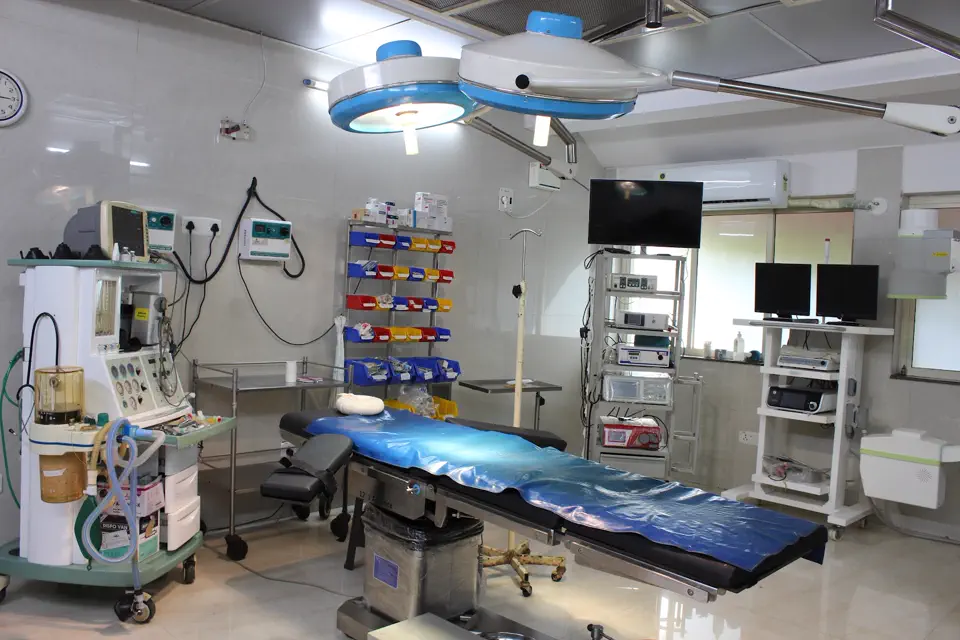
The operation is done in the hospital's own operating theatre at Vaddem, Vasco-da-Gama, with its laparoscopic tower: the camera unit and the screen the surgeon works from. The anaesthesia is given by an anaesthesiologist, a specialist doctor, using an anaesthesia machine with a patient monitor; the wires and breathing circuits are single-use, new for every patient. Nurses look after you in theatre and on the ward, and the hospital has three registered doctors on staff. Your tests, the operation and your stay are all in this one building, with one team, and the hospital is open 24 hours for pregnancy and gynaecology emergencies.
Women from Margao and South Goa can consult in Margao or at this same hospital; read how their visits are planned on our page for a gynaecologist in Margao. If you are coming from elsewhere in Goa for the consultation or the operation, we send a car for you and bring you home again, at zero cost to the patient.
For the uterus-removal route with no abdominal cut at all, see scarless (vaginal) hysterectomy. For fibroids specifically, see fibroid treatment in Goa and myomectomy. For what affects the cost of surgery, see cost of laparoscopic surgery in Goa.
Questions women ask
Straight answers about heavy periods, fibroids, PCOS, keyhole surgery and recovery: Gynaecology and surgery: your questions answered.
Can an ovarian cyst be removed by keyhole surgery?
Yes, when removal is needed. Laparoscopic removal (cystectomy) is kept for cysts that persist over several cycles, are large, look complex on scan, or are causing pain. The aim is to remove the cyst while leaving the healthy ovary tissue in place.
Who does laparoscopic surgery in Goa at Pai Hospital?
Our consultant obstetrician and gynaecologist (MBBS, MS OBG), a laparoscopic surgeon in practice for 15 years, does these operations himself, in the hospital's own operating theatre at Vaddem, Vasco-da-Gama. The doctor you consult is the doctor who operates, and the anaesthesia is given by an anaesthesiologist.
How many days will I be in hospital after laparoscopic surgery?
Most laparoscopic gynaecological operations here are a one- or two-night stay, and some, such as a diagnostic laparoscopy or a hysteroscopy, are day-care. After a keyhole hysterectomy, for example, most women go home in one to two days. You are told what to expect for your operation before you are admitted.
Is laparoscopic surgery done under general anaesthesia?
Usually, yes. A laparoscopy is normally done under general anaesthesia, so you are asleep and feel nothing during the operation. It is given by an anaesthesiologist, a specialist doctor, who sees you before the operation and tells you when to stop eating and drinking. A hysteroscopy on its own is shorter, and its anaesthesia is planned for you depending on what is being done.
Can laparoscopy and hysteroscopy be done together?
Yes. When both the inside and the outside of the womb need a look, the two are often done in the same sitting, under one anaesthetic. Done together to find a cause, for example when a couple is trying for a pregnancy, this is called a diagnostic hysterolaparoscopy. A problem that is found can sometimes be treated in the same sitting, if you agreed to it beforehand.
How long is recovery after laparoscopic surgery, and will there be scars?
Expect mild soreness around the small cuts and some shoulder-tip discomfort for a day or two. Most women are back to light activity within a week or two and to full activity within four to six weeks; after a keyhole hysterectomy, most are back to light work in two to three weeks. The two or three cuts are each under a centimetre, so the scars are small and fade with time.
What decides the cost of laparoscopic surgery?
The operation you need matters most, then the route it takes (keyhole, vaginal or open) and how many nights you stay. You get a written estimate after the consultation and your scan, before a date is fixed. See what affects the cost of laparoscopic surgery in Goa.
Or call +91 95459 20817 · +91 75582 52088 · 0832 251 3641
This page is for general education and is not personal medical advice. Treatment depends on your own examination and reports, so please speak to a doctor about your situation. We do not carry out or offer sex determination of any kind.